Real Estate
Real Estate 2036
The Transition: Why the real estate industry underestimates the scale of its own disruption · White Paper · August 2026
The central claim: a building is capitalized human labor. AI is not primarily optimizing the industry’s processes, it is repricing its foundation: the demand for space that exists because people are paid to work in a place. The transmission runs through three channels: occupier incomes, operator economics, and capital-market benchmarks. Germany is the hardest test case – export-dependent, aging, highly regulated, with roughly €20 trillion in property wealth. 60+ pages, 24 chapters, more than 60 sources. A scenario, not a forecast.
Key findings
- Leases are preserves: the office market has not yet seen the 2026 management cuts in a single space metric, the vacancy rate measures the wrong thing.
- Divergence, not collapse: the same AI that empties administrative floors fills AI clusters. San Francisco provides the pattern (30% of leasing from AI firms); Munich and Berlin are the candidates.
- The double shock in residential: the boomer supply wave meets repriced buyer incomes; the rental market becomes the relative winner, with a capped upside.
- The reflexivity of data centers: the industry builds and celebrates the asset class that reprices demand for all the others – and calls it diversification.
- The countercase is in the paper: eight objections at full strength, including the Jevons paradox and the JLL/MIT study, plus twelve early indicators with kill switches that make the paper falsifiable.
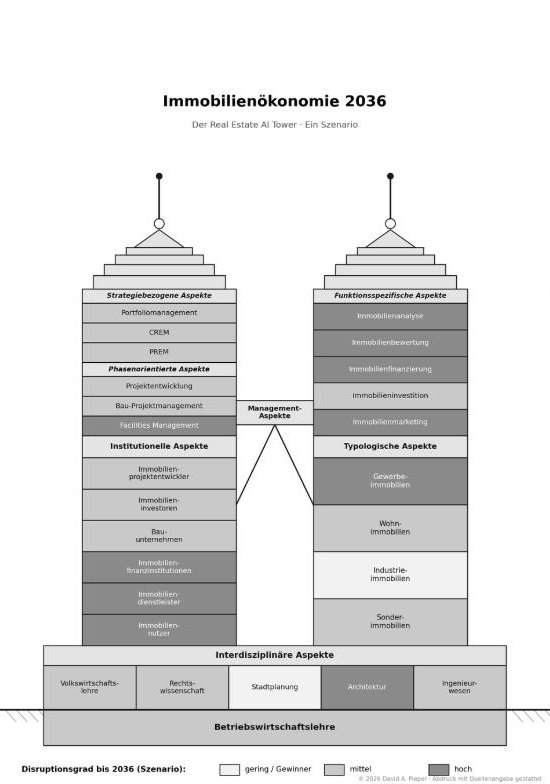
Figure from the paper
This document is for discussion purposes only. It constitutes neither investment advice nor an offer or solicitation to buy or sell any financial instrument. Past performance is not a reliable indicator of future results. All information given to the best of the author’s knowledge; data as of August 2026. © 2026 · All rights reserved. Quotation with attribution is expressly welcome.