Capital Markets
The Edge of Tail Risk Catching
Insurance against the chaos scenario in the amplifier regime · White Paper · First Edition · August 2026
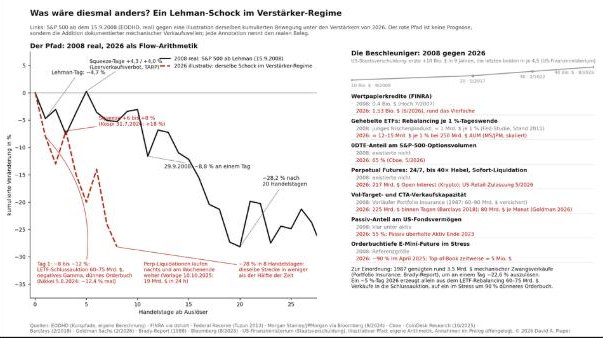
The central claim: you do not need to know the scenario to run the numbers. A Lehman shock today would meet four times the 2007 credit load, forced sellers that did not exist in 2008, and an order book that is 90 percent thinner under stress; in that arithmetic, the Lehman day of minus 4.7 percent becomes a day of minus 8 to minus 12 percent. Tail risk hedging is therefore not a bet but the portfolio’s fire policy: budgeted like an insurance premium, built from convex instruments, monetized by rules written before the event. A good 70 pages, 12 chapters, 62 footnotes. A framework, not a forecast.
Key findings
- Not more frequent, but faster: 26 drawdown episodes of 10 percent or more in the S&P 500 since 1950. From the peak to the minus-10-percent mark once took well over 70 trading days in the median; since 2018 the same path has been covered three times in 16 days or fewer (2018: 9, 2020: 6, 2025: 16).
- The Liberation Day case study of 2025, computed with real market prices: the put 10 percent out of the money paid eleven times the premium at the trough – and expired worthless for anyone who did not monetize. Monetization is half the discipline.
- The House of Hedging: from the LEAP roof (around 1 to 1.5 percent annual premium, survives the false alarm with 70 to 80 percent residual value) through single-name puts to CDS – and what tail hedging is not: diversification, private markets, spreads.
- The framework: not a position size but a premium budget of 0.5 to 1.5 percent of the insured assets per year, run like an insurance premium, with monetization rules written before the event.
- The countercase is in the paper: the AQR critique at full strength, the carry of a multi-year bull market (TAIL ETF: minus 51 percent cumulative) and the paper’s limits in chapter 12.
Figure from the paper
This document is for discussion purposes only. It constitutes neither investment advice nor an offer or solicitation to buy or sell any financial instrument. Past performance is not a reliable indicator of future results. All information given to the best of the author’s knowledge; data as of August 2026. © 2026 · All rights reserved. Quotation with attribution is expressly welcome.